
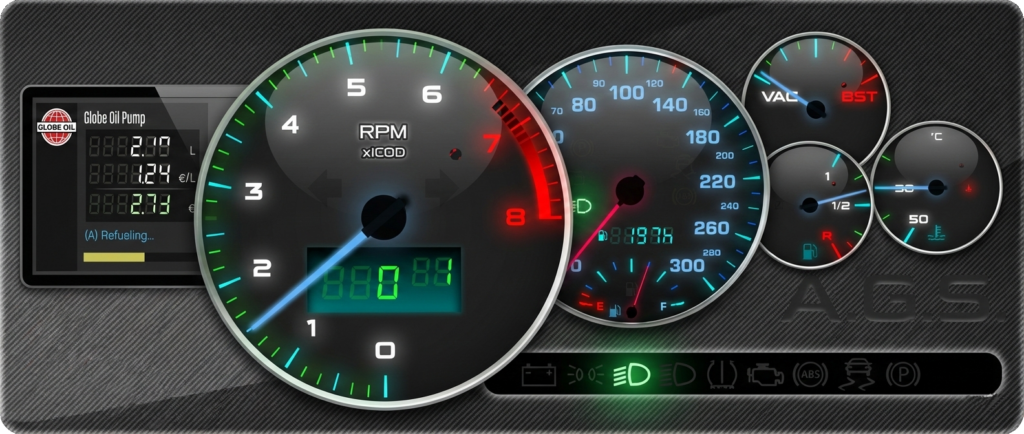
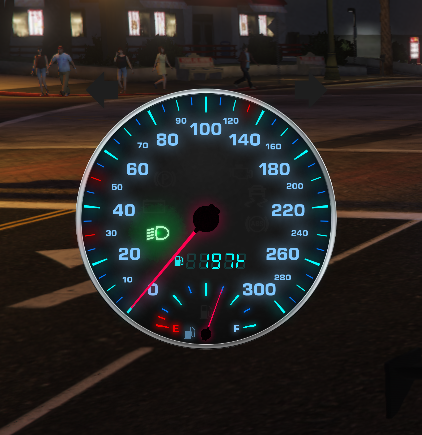
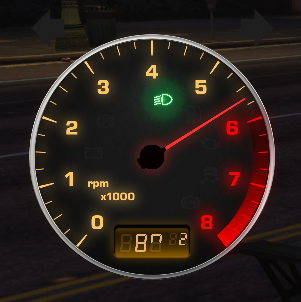
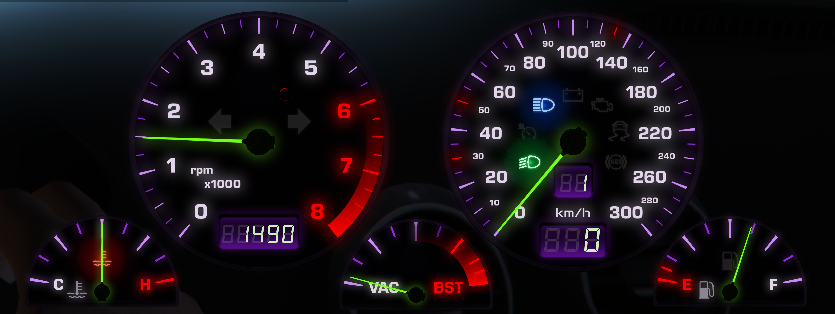
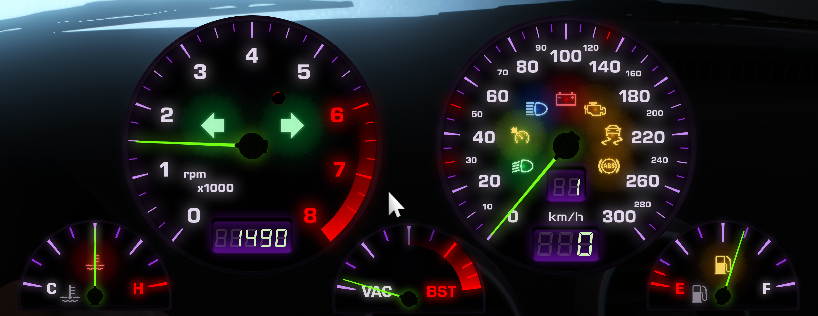
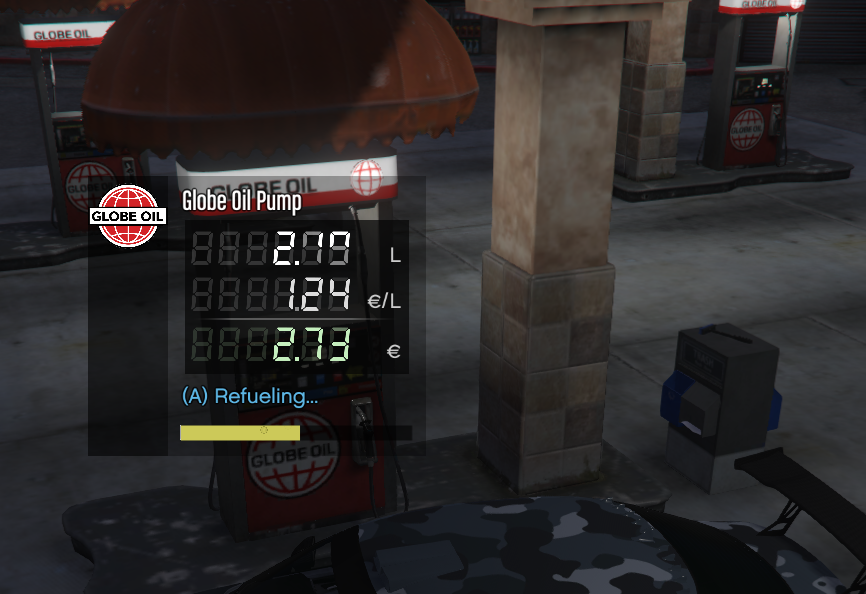
Most vehicles in GTA V behave like indestructible slot cars: you floor the accelerator, the car moves forward, and the dashboard gauges serve as static decorations. The Accurate Gauge System (A.G.S.) fundamentally changes how you interact with vehicles by replacing basic arcade driving mechanics with a physics-based simulation framework and a modular dashboard HUD.
By tracking mechanical stresses, aerodynamic drag, electrical loads, and environmental factors, A.G.S. transforms standard driving into an authentic management experience where every vehicle has a unique history and physical limits.
1. Deep Mechanical & Environmental Simulation
A.G.S. runs a continuous physics engine in the background to calculate vehicle performance, efficiency, and component wear based on real-time driving conditions.
- Advanced Fuel Consumption Physics: Fuel depletion is determined by true mechanical workload rather than simple distance variables. The engine evaluates throttle intensity, engine RPM, total vehicle weight, and specific drag or load factors:
- Aerodynamic Drag: Driving a vehicle with structural damage, such as missing doors or hoods, increases air resistance and burns fuel faster.
- Electrical Load: Running high-draw auxiliary components, such as police lightbars and sirens, places an extra load on the alternator, impacting fuel usage.
- Weight & Towing: Pulling heavy trailers or towing other vehicles increases the engine’s required output, accelerating fuel drain.
- Terrain & Surface Logic: Driving surface conditions impact traction and rolling resistance. Moving through deep mud or loose sand forces the engine to work harder to maintain speed. Navigating steep hills or mountain inclines demands higher torque and significantly increases fuel consumption.
- Gas Station Quality Variation: The fuel stations distributed across San Andreas are fully functional, but they are not identical. Fuel quality varies depending on the station you choose. Utilizing low-grade fuel can cause the engine to stutter or misfire under intense acceleration or during high-speed travel.
- Thermal Dynamics & “Cold Start” Behavior: Engines do not run optimally the moment you turn the key. A.G.S. simulates thermal curves, meaning a cold engine requires time to reach its efficient operating temperature for peak performance. Conversely, pushing a vehicle too hard for extended periods—especially in the desert heat—can lead to “Heat Soak” and reduced efficiency.
- Intelligent Vehicle Initialization: Every vehicle you enter has an existing history. When you get into a car, its initial fuel level is randomized based on the neighborhood and vehicle type. You might step into a well-maintained luxury car in Rockford Hills with a full tank, or find a neglected sedan in Blaine County running on fumes.
- Selectable Simulation Modes: Adjust the difficulty of the fuel simulation to match your playstyle:
- Casual: Forgiving consumption rates, ideal for relaxed driving.
- Standard: A balanced setting where a full tank lasts roughly 20 to 30 minutes of continuous driving.
- Hardcore: Aggressive scaling where hard acceleration and heavy loads drain the fuel tank rapidly.
2. Dynamic Dashboard & Gauge Behavior
Rather than drawing static layout overlays, the visual HUD framework reacts directly to physical forces and mechanical feedback.
- Mechanical Needle Fidelity: Gauges mimic physical instrument components. You will see the subtle “wobble” of an aging engine at idle and the violent bounce of the needle when hitting the rev limiter.
- Fluid Physics Emulation: The fuel gauge does not act like a rigid progress bar; it simulates a tank of liquid. The fuel needle will visibly shift and “slosh” when you enter hard corners, slam on the brakes, or accelerate rapidly.
- Automated Texture Swapping: The system reads the true capabilities of your current vehicle. Cars with high-RPM redlines will automatically switch to a corresponding dashboard texture layout that accurately represents their rev limits.
- Live Trip Computer: Runs background calculations on your rolling fuel economy, translating metrics down to liters per meter. It combines this history with your current driving behavior to display a dynamic, predictive distance-to-empty range estimator.
- Automatic Unit Detection: The system automatically detects your region’s measurement units (Miles/Gallons/Fahrenheit/$ or KM/Liters/Celsius/EUR). You can easily override these preferences manually via the settings menu.
- Day & Night Backlighting: Textures respond directly to ambient game lighting and your vehicle’s headlight status, automatically activating dashboard backlighting or swapping to night-adapted texture profiles when darkness falls.
3. The Tactical Symbol Cluster
The Symbol Cluster is a standalone, real-time diagnostic dashboard suite that displays crucial mechanical alerts and vehicle states exactly when they occur.
- Critical Alerts (Red): Immediate warnings indicating critical mechanical failures, including low oil pressure, battery voltage drops, excessive engine temperature, and braking system issues.
- Mechanical Safety (Amber): Live status updates for driver assist systems, tracking anti-lock brake (ABS) activation, tire pressure fluctuations, and check engine triggers.
- Lighting & Signals: Visual feedback for high beams, daytime running lights, independent front or rear fog lights, and synchronized turn signal indicators.
- Assist Synchronization: Displays dedicated indicators whenever Cruise Control or the Speed Limiter is active, giving you visual confirmation that the vehicle’s automated throttle systems are managing road speed.
4. Professional Driver Assists
A.G.S. includes precision driving systems designed to manage vehicle speed during long patrol shifts or coordinated maneuvers.
- PID-Controlled Cruise Control: Uses a proportional-integral-derivative feedback mechanism to maintain exact road speeds smoothly, adjusting throttle inputs automatically to compensate for steep hills or rolling resistance.
- Speed Limiter: Sets a strict hard cap on your engine’s maximum speed output, allowing you to floor the pedal safely without exceeding local speed limits or breaking formation with other vehicles.
5. Live In-Game Configuration Suite
You do not need to edit text configuration files or restart your game to adjust your setup. The plugin includes an interactive menu and visual layout manager.
- Live HUD Editor: Open the editor configuration to adjust screen layout positioning and scale parameters on the fly. You can activate a placement mode to select, move, and arrange your gauge elements directly on screen using interactive sliders or adjustment keys.
- Visual Inspector: Toggle individual sub-components, change gauge colors, or switch active layout features in real time. Create anything from a minimal modern display to a complex, retro cruiser dashboard layout.
- Profile Management: Save, load, and export your custom skin modifications and color palettes. A.G.S. ships ready to use with 2 texture packs, 5 base skins, and 31 pre-configured color palette presets.
6. Installation & Controls
Installation
A.G.S. requires a dedicated DLC archive to load assets correctly. The download package contains both an automated LML package and manual installation files. Detailed step-by-step instructions are provided in the download folder.
Default Controls
All inputs can be customized via the in-game system settings menu. If the default menu key conflicts with another active plugin, you can rebind it at any time using the console command: SetAGSMenuKey.
- Open Settings Menu:
F11 - Position & Move Gauges: Hold
F12while dragging or adjusting elements - Refuel Vehicle: Hold
Nfor manual fuel pumping, or double-tapNto auto-refuel - Toggle Cruise Control:
T - Toggle Speed Limiter:
Shift + T - Adjust Cruise / Limiter Target Speed:
PageUp/PageDown - Adjust ACC Gap:
Shift + PageUp / PageDown
7. Custom Skin Design: Architectural Rules
For texture designers and creators building custom dashboards, the A.G.S. rendering engine processes layouts using specific, strict structural rules to ensure perfect performance and visual alignment.
1. The Square Canvas Rule
- Dimensions: All custom textures must be authored on a perfectly square canvas (e.g.,
512x512pixels). - The Center-Point: The engine renders every layout layer using identical screen coordinates, rotating the needle component around the absolute center of the square (
256, 256). - Alignment: You must center your gauge face artwork and the exact pivot “pin” of your needle perfectly within your image editing software. The code does not apply manual positional offsets to individual layers.
2. Hardcoded Texture Naming Conventions
The system’s internal resolver automatically builds texture requests based on the active Gauge Type, Layer Name, and environmental suffixes. Textures inside your dictionary (.ytd) must match these specific base names:
| Layer Key | Texture Base Name | Description / Purpose |
| TX_UNDERLAY | UNDERLAY | The primary static background and face of the gauge. |
| TX_FILL | FILL | Background backing layer for digital readouts or solid color fills. |
| TX_NEEDLE | NEEDLE | The rotating needle asset. |
| TX_NUMBERS | NUMBERS | The numerical dial markings (supports Metric/Imperial variations). |
| TX_LABEL | LABEL | Text indicators (e.g., “MPH”, “RPM”, “FUEL”). |
| TX_LED_ON / OFF | LED_ON / LED_OFF | Status indicators and warning light states. |
| TX_REDLINE | REDLINE | Visual markings for high-RPM limits. |
| TX_LMAJOR / LMINOR | LINES_MAJOR / LINES_MINOR | Primary and secondary gauge tick marks. |
| TX_GLASS | GLASS | A semi-transparent glass reflection overlay. |
3. Naming Assembly & Fallbacks
The system queries textures using a strict PREFIX_BASENAME_SUFFIX pattern.
- Prefixes: Appended automatically based on the monitored vehicle metric (
SPEEDO_,FUEL_,TURBO_,OIL_,TEMP_). - Suffixes: *
_KMHor_MPHare appended toNUMBERSandLABELlayers depending on the user’s active configuration._NIGHTis appended to all primary layers when the vehicle’s headlights are turned on.
- Fallback Logic: If the engine requests
SPEEDO_NUMBERS_KMH_NIGHTand it is missing from the texture dictionary, it will automatically search forSPEEDO_NUMBERS_KMH. If that is also missing, it falls back to the baseSPEEDO_NUMBERStexture.
4. Speedometer Calibration
- Linear Layouts: Standard fixed-degree rotation tracking (e.g., exactly 1 degree of physical needle rotation per 1 MPH increase).
- Non-Linear Layouts: For authentic dashboard replication, you can define custom degree-per-unit
SpeedMapsinside your configuration files. This allows the needle to register accurately even if the spacing between numbers or tick lines varies across the face of the dial.
5. Optimization Guidelines
- Resolution Artifacts: Stick strictly to
512x512resolution templates. Forcing larger textures causes the rendering engine to downsample the assets at runtime, which introduces a distracting “shimmering” or blurry artifact on the dashboard. - Dynamic Color Tinting: Design your
NEEDLE,FILL, andLEDtextures completely in grayscale or pure white. This enables the in-game color palette manager to apply custom RGB tint colors directly to the texture dynamically while driving. - Layer Toggling (Flags): If your custom skin does not use a specific layer (such as a separate
REDLINEorGLASSoverlay), disable that layer flag in your layout configuration file to bypass rendering updates and maximize performance.
Credits:
khorio
Download mod
| File | File size |
|---|---|
 A.G.S. v1.1.2348.4 LML + MANUAL
 | 30 MB |
